
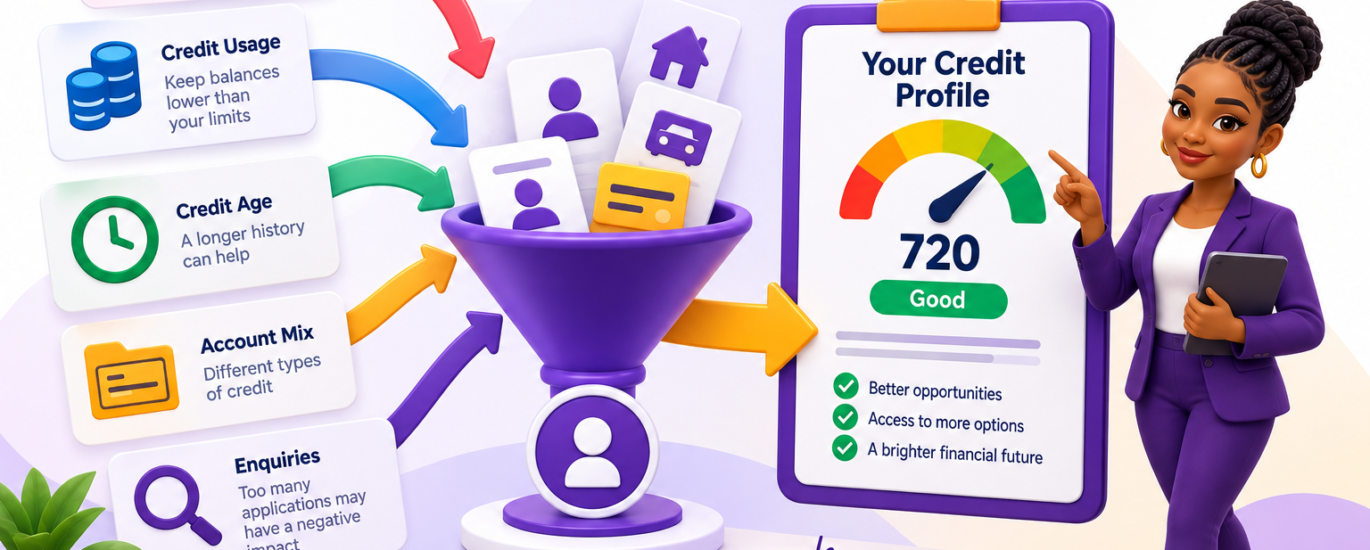
Understanding Your Credit Score, Credit Profile and Why Having a Good Score Does Not Always Mean Your Credit Application Will Be Approved
Many South Africans know that having a good credit score is important. We are often told to pay our accounts on time, avoid unnecessary debt and maintain a good credit record.
However, one question continues to confuse many consumers:
“If I have a good credit score, why was my application for credit declined?”
The answer is that your credit score is important, but it is only one part of your overall financial profile.
When you apply for a personal loan, vehicle finance, home loan, credit card, retail account or another credit product, the credit provider may consider several pieces of information before deciding whether to approve your application.
Your credit history matters.
Your existing debt matters.
Your income and expenses matter.
Your affordability matters.
The way you have managed previous credit agreements matters.
Understanding these factors can help you make better financial decisions and avoid applying for credit without first understanding your financial position.
At BK Credit Solutions, we believe that financial education is an important part of helping consumers take control of their finances.
This guide explains some of the important factors that may affect your credit profile and what you should consider before applying for additional credit.

1. What Is a Credit Score?
A credit score is a numerical representation of information contained in your credit profile.
Credit bureaus collect information about how consumers manage credit agreements. This information can include your accounts, repayment history, outstanding balances, credit enquiries and other information that forms part of your credit record.
Using information contained in your credit report, a credit bureau may calculate a credit score.
The score helps provide an indication of your credit risk based on the information available to the bureau.
However, it is important to understand something that many consumers do not realise:
There is no single credit score that guarantees approval for credit.
Different credit bureaus may use different scoring models and score ranges. Credit providers may also have their own internal assessment methods.
This means the score you see when checking your credit report is not necessarily the only score or assessment that a bank or other credit provider will consider.
A credit provider may consider your credit bureau information together with your income, expenses, existing financial commitments, affordability and its own lending requirements.
Your credit score should therefore be viewed as an important indicator of your credit health, not as a guarantee that a credit application will be approved.
2. What Information Can Affect Your Credit Profile?
The exact method used to calculate a credit score can differ between credit bureaus.
For this reason, consumers should be careful about assuming that specific percentages apply to every credit bureau or every lender in South Africa.
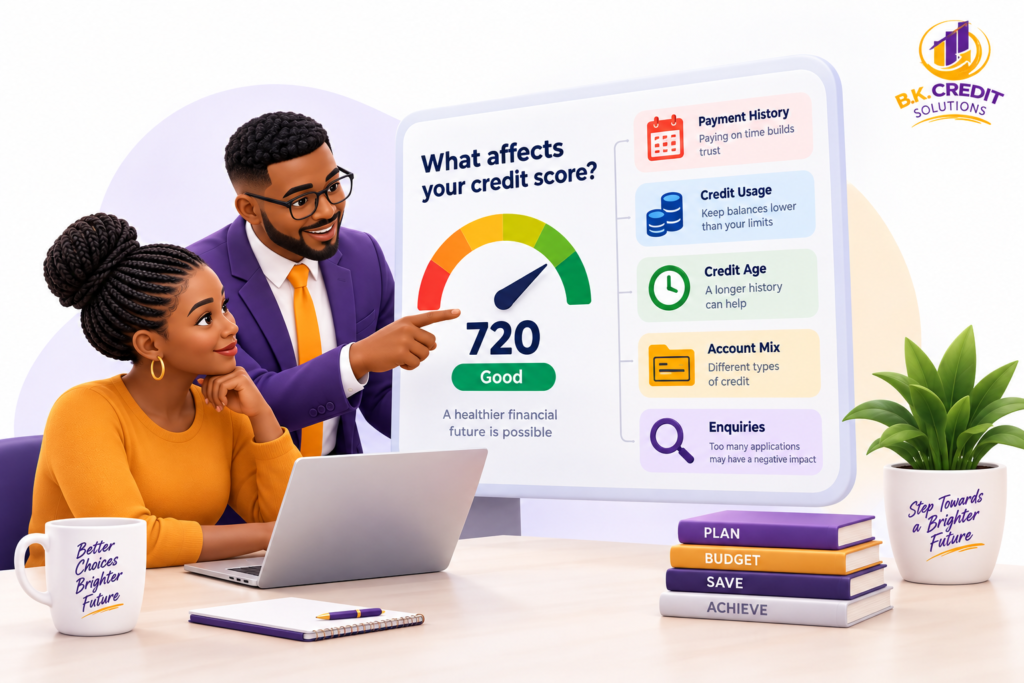
There are, however, several important areas that commonly influence your overall credit profile.
These include:
- Your payment history
- The amount of credit you are currently using
- The length of your credit history
- The types of credit accounts you have
- Your recent applications for credit and credit enquiries
Let us look at each of these in more detail.
3. Your Payment History
Your payment history is one of the most important parts of your credit profile.
When you enter into a credit agreement, you agree to make certain payments according to the terms of that agreement.
Your credit report can therefore show how you have managed those payments over time.
For example, it may reflect whether payments were made according to the agreement or whether an account has fallen into arrears.
Why does payment history matter?
Credit providers want to understand how you have managed your existing and previous financial obligations.
If you consistently pay your accounts according to the agreed terms, this may contribute positively to your credit profile.
If you repeatedly miss payments, pay late or allow accounts to fall significantly into arrears, this may negatively affect your credit profile.
This is why consumers should try to avoid treating account payments as something that can simply be skipped whenever money becomes tight.
If you are experiencing financial difficulty, it may be better to understand your financial position and seek appropriate assistance rather than continuously missing payments without addressing the underlying problem.
Good financial habits may include:
Paying accounts by their due dates.
Keeping track of debit orders.
Reviewing monthly statements.
Creating a realistic monthly budget.
Knowing exactly how much you owe.
Avoiding taking on debt that you cannot realistically afford.
Seeking assistance early when repayments become difficult.
Your credit profile develops over time. Consistent financial behaviour can therefore be more important than trying to find a quick solution immediately before applying for credit.
4. How Much of Your Available Credit Are You Using?
Another important consideration is how much credit you already have available and how much of it you are currently using.
This is particularly relevant to revolving credit facilities such as credit cards and certain store accounts.
Consider this example.
You have a credit card with a limit of:
R20,000
Your outstanding balance is:
R19,000
Although you may still be making your required monthly payments, you are using a large portion of the credit available to you.
Compare this with someone who has the same R20,000 limit but currently owes R4,000.
The two consumers may both be paying their accounts, but their use of available credit is very different.
Using a large portion of your available revolving credit can potentially indicate that you are heavily dependent on credit.
This does not automatically mean that your application will be declined. It is simply one of the factors that can contribute to your overall credit profile.
Should you increase your credit limit to improve your score?
Consumers should be careful with this approach.
The goal should not simply be to manipulate a credit score.
The more important goal is to maintain healthy financial behaviour.
Having access to additional credit can become dangerous if it encourages you to borrow more than you can comfortably repay.
A healthier question is:
“Am I using credit responsibly and can I comfortably afford my current financial commitments?”
5. The Age of Your Credit History
Your credit history develops over time.
Someone who has managed credit accounts responsibly for several years may have a longer financial history available for assessment than someone who has only recently started using credit.
A longer credit history can provide more information about how a consumer manages financial obligations.
However, having an old account does not automatically mean you have a good credit profile.
The quality of your repayment behaviour remains important.
For example, a consumer may have had an account for eight years, but if that account regularly falls into arrears, the age of the account alone does not make the overall history positive.
The important lesson is that building a healthy credit profile generally takes time.
There is rarely a responsible overnight solution for building a strong credit history.
6. Your Mix of Credit Accounts
Consumers can have different types of credit.
Examples can include:
- Home loans
- Vehicle finance
- Personal loans
- Credit cards
- Retail accounts
- Other qualifying credit agreements
Different types of credit may be reflected differently within your overall credit profile.
However, this does not mean you should open several different accounts simply because you want to create a “better credit mix.”
Taking unnecessary credit can create additional monthly commitments and increase financial pressure.
Your objective should always be responsible financial management.
You should borrow because you genuinely need the credit, understand the agreement and can afford the repayments.
You should not borrow simply because you are trying to create a particular credit profile.
7. Credit Applications and Enquiries
Every time you apply for credit, the credit provider may obtain information about your credit profile as part of its assessment.
Credit enquiries may appear on your credit report.
This becomes particularly important when consumers are declined for credit and immediately begin applying at several other institutions.
For example:
You apply for a personal loan at one institution and are declined.
You then apply at another institution.
You are declined again.
You apply for a credit card.
You apply for vehicle finance.
You then apply for another personal loan.
Instead of solving the original problem, repeated applications may create additional enquiries on your credit profile.
The better approach may be to first understand why you are struggling to obtain credit.
The problem may not necessarily be your credit score.
It could relate to affordability, existing debt, your income and expenses, information contained in your credit report or the particular credit provider’s assessment requirements.
8. A Good Credit Score Does Not Guarantee Credit Approval
This is perhaps the most important lesson in this article.
Imagine that you check your credit profile and see a score that appears to be good.
You then apply for credit.
Your application is declined.
You may immediately assume:
“There must be something wrong with my credit score.”
That is not necessarily the case.
The credit provider is not only interested in whether you have historically managed credit responsibly.
It must also consider whether you can afford the new financial obligation.
This brings us to another very important subject.
Affordability
A consumer can potentially have a relatively healthy credit profile but still have limited disposable income.
For example, consider a person earning:
R25,000 per month
At first glance, R25,000 may appear to be sufficient income for additional credit.
However, that person might already have monthly commitments such as:
Rent or bond: R7,500
Vehicle repayment: R4,500
Existing loan: R2,000
Insurance: R1,500
Transport or fuel: R2,000
Groceries: R3,500
School expenses: R1,500
Other household expenses: R1,500
The important question is no longer simply:
“How much does this person earn?”
The more important question becomes:
“After reasonable expenses and existing financial commitments, how much money does this person actually have available for another repayment?”
This is one reason why a consumer can have a seemingly good credit score and still have a credit application declined.
9. Why Your Bank Statements Can Matter
Your bank statement can provide important information about your actual financial activity.
While a credit report helps provide information about your credit history, your bank statements can provide insight into your income, expenses and financial commitments.
Depending on the type of application and credit provider, the assessment process may consider information relating to your income and expenditure.
This is why consumers should not focus exclusively on their credit score.
You could potentially have a good repayment history while your current monthly finances are under significant pressure.
For example, your accounts may all be paid on time, but after those payments are made, you may have very little money remaining.
That can become an affordability issue.
We will explore affordability assessments and bank statements in more detail in a separate BK Credit Solutions consumer education article.
10. What Should You Do Before Applying for Credit?
Before submitting another application, take some time to understand your overall financial position.
Ask yourself the following questions:
Do I know what is on my credit report?
Consumers should periodically check their credit reports.
Do not wait until you urgently need vehicle finance, a home loan or another financial product before discovering what your credit report contains.
Is the information on my credit report correct?
Mistakes can occur.
An account may potentially be incorrectly reflected, information may require updating or you may identify information you do not recognise.
If you believe information is inaccurate, you should follow the appropriate dispute process with the relevant credit bureau.
Are all my accounts up to date?
Check your repayment history and identify any accounts that may be in arrears.
How much debt do I currently have?
Write down all your credit commitments.
Many people know approximately what they owe, but do not know the total amount.
Understanding your total debt position is an important part of financial planning.
How much do I spend every month?
Calculate your real monthly expenditure.
Include expenses such as:
Housing
Transport
Food
Electricity
Insurance
School expenses
Medical expenses
Existing credit repayments
Subscriptions
Family responsibilities
Other regular commitments
How much money remains after all my expenses?
This gives you a better understanding of your disposable income.
Do I actually need additional credit?
This is one of the most important questions.
Credit can be useful when managed responsibly, but it should not become the permanent solution to a monthly cash-flow shortage.
If you regularly need new loans to repay existing loans or meet normal household expenses, there may be a deeper financial problem that requires attention.
11. What If There Is Incorrect Information on Your Credit Report?
Consumers should understand the difference between incorrect negative information and correct negative information.
If information on your credit report is incorrect, you have the right to follow the appropriate process to dispute it.
For example, you may discover an account that does not belong to you or information that you believe has been incorrectly recorded.
That should be investigated through the proper channels.
However, consumers should be cautious of anyone promising to simply “remove” accurate negative information or guarantee a particular credit score.
A legitimate credit assistance service should first understand the consumer’s circumstances and determine what appropriate process may be available.
At BK Credit Solutions, our approach is based on understanding your situation and identifying appropriate options rather than promising guaranteed results.
12. How Can You Work Towards a Healthier Credit Profile?
Improving your overall credit health is normally about consistent financial behaviour rather than quick fixes.
Consider the following principles.
Pay your accounts according to the agreed terms.
Where possible, avoid missed and late payments.
Know how much you owe.
Keep track of your outstanding balances and monthly repayments.
Avoid unnecessary debt.
Do not take credit simply because it is available.
Be careful with repeated credit applications.
If applications are repeatedly being declined, first try to understand the underlying reason.
Review your credit report.
Know what lenders may see when assessing your credit profile.
Create and maintain a monthly budget.
Your financial health is bigger than your credit score.
Address financial problems early.
Do not wait until several accounts are deeply in arrears before looking for assistance.
13. Are You Using New Debt to Pay Old Debt?
This is an important warning sign.
Some consumers reach a stage where they borrow money to pay another debt.
For example:
You take a personal loan to pay a credit card.
You then use the credit card for groceries because your salary is finished.
You take another short-term loan to cover debit orders.
The following month, you need another loan because your existing repayments have increased.
This can become a difficult debt cycle.
At this stage, the biggest concern may no longer be your credit score.
The bigger concern may be whether your current debt obligations are sustainable.
Applying for additional credit without addressing the underlying financial pressure can potentially make the situation more difficult.
This is where getting an assessment of your financial position may be more useful than simply trying to improve a number on your credit report.
14. Your Credit Score Is Not Your Entire Financial Picture
A credit score can be useful.
It can help you understand part of your credit profile.
But your financial health includes much more than one number.
You should also consider:
Your total debt.
Your monthly repayments.
Your household expenses.
Your income.
Your disposable income.
Your savings.
Your ability to deal with emergencies.
Your financial commitments.
Your repayment history.
Your future financial goals.
A person with a good credit score but unsustainable monthly debt commitments may still be financially vulnerable.
Likewise, someone who has experienced previous financial difficulties can start taking responsible steps towards improving their financial position.
The objective should therefore not simply be:
“How do I increase my credit score?”
A better objective is:
“How do I improve my overall financial position?”
15. When Should You Consider Getting Professional Assistance?
You do not necessarily have to wait until you are completely unable to pay your accounts before seeking guidance.
You may consider getting assistance if:
You do not understand your credit report.
You believe information on your credit report may be incorrect.
Your credit applications are repeatedly being declined.
You are struggling to keep up with monthly repayments.
Your debt repayments consume a large portion of your income.
You are using one form of credit to pay another.
You are constantly relying on credit before payday.
You have fallen behind on several accounts.
You are receiving collection calls and letters.
You are unsure whether debt counselling or another solution may be appropriate.
You are already under debt review and need clarity regarding your status or the appropriate process going forward.
Seeking information early can help you understand the options that may be available.
How BK Credit Solutions Can Assist
At BK Credit Solutions, we understand that every consumer’s financial situation is different.
Two people can earn the same salary and still have completely different financial circumstances.
For this reason, the first step should be understanding your situation.
Depending on your circumstances and the nature of the assistance required, our services may include:
Credit Report Assistance
We can help you better understand information appearing on your credit report and the appropriate processes available where information may require attention.
Debt Assessment
If you are struggling with your financial commitments, an assessment can help provide a clearer picture of your income, expenses and debt obligations.
Debt Counselling and Debt Review
For qualifying over-indebted consumers, debt counselling is a formal process provided for under South Africa’s National Credit Act and must be handled through an appropriately registered debt counsellor.
Budget Coaching
Understanding where your money goes every month can be an important first step towards improving your financial position.
Debt Settlement Support
Depending on the circumstances, consumers may require assistance understanding or engaging around settlement options. Any settlement remains subject to the relevant creditor’s agreement and should never be presented as a guaranteed discount.
Debt Review Status, Exit and Clearance Guidance
Consumers who are already under debt review may need assistance understanding their current status and the processes that may apply to their circumstances.
Credit Monitoring and Financial Wellness
Financial wellness is not something that should only receive attention when you need a loan. Regularly reviewing your financial position can help you make more informed decisions.
Take Control Before You Apply Again
If your credit application has been declined, your first reaction may be to apply somewhere else.
Before doing that, consider finding out what may be affecting your financial profile.
Your credit score may be part of the answer, but it may not be the whole answer.
The issue could relate to your repayment history.
It could relate to your current debt.
It could relate to information appearing on your credit report.
It could relate to affordability.
It could relate to your income and expenses.
Or it could relate to the particular credit provider’s assessment criteria.
Understanding your position gives you an opportunity to make more informed decisions.
Need Help Understanding Your Financial Position?
If you are unsure about your credit report, struggling with debt or need assistance understanding the options available to you, contact BK Credit Solutions.
Our goal is to help you understand your financial position and identify an appropriate way forward based on your circumstances.
BK Credit Solutions
NCRDC4390
031 054 5937
071 713 7064
071 726 6928
Email: info@bkcreditsolutions.co.za
Step Towards a Brighter Future
